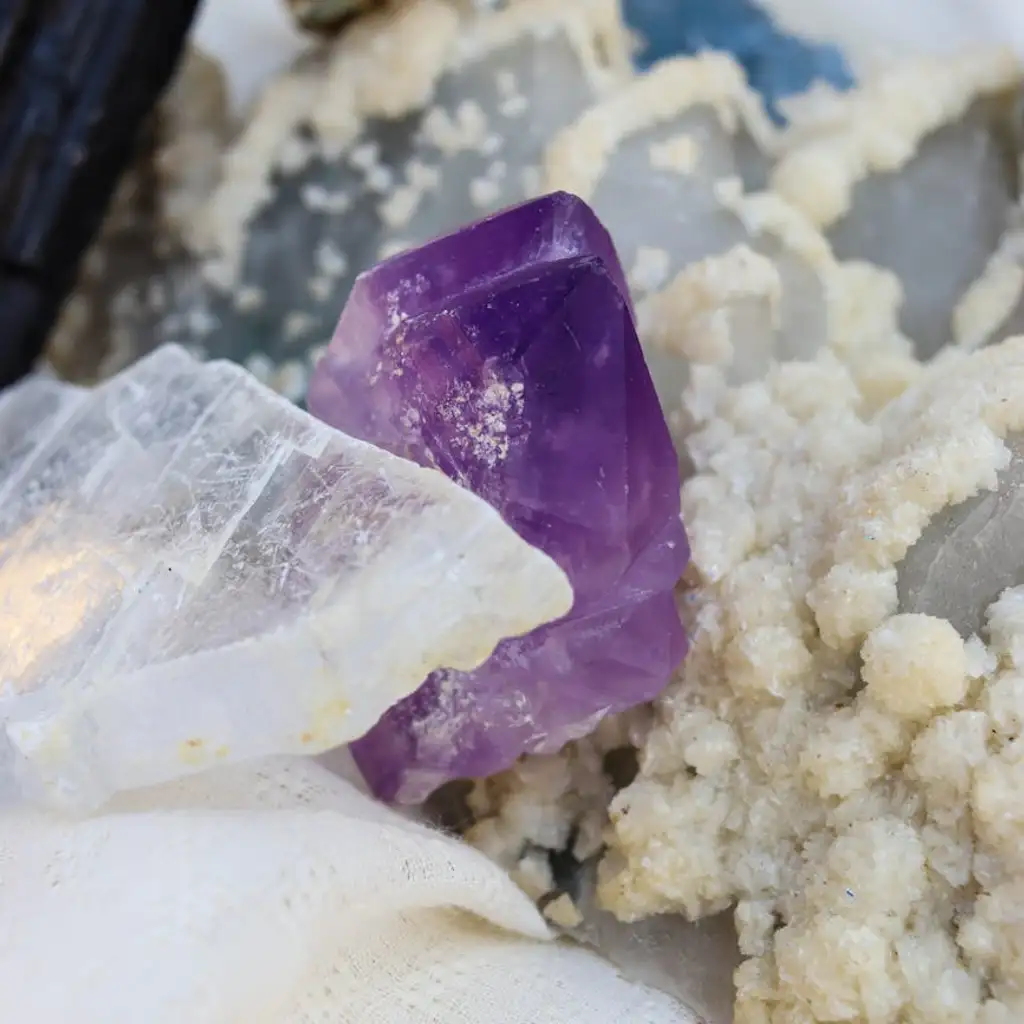
In a dimly lit warehouse near Seattle, Richard Berger’s remarkable collection of massive minerals awaits a new home. Berger is actively seeking a patron with the means to purchase the “Masterpieces of the Earth” and create a museum to display these natural wonders.
Unlike many who start collecting minerals in childhood, Berger’s fascination began in his twenties. Raised in the Bronx, he first encountered quartz during a cross-country journey in 1968. Disenchanted with medical school, he stumbled upon a rock shop in Wyoming, where a small crystal captivated him with its beauty.
Now, over forty years later, Berger and his wife have curated one of the most impressive private collections of crystals, fossils, and natural marvels globally. Highlights include an amethyst geode as large as a compact car, a nearly four-foot-wide ammonite fossil, a 700-pound pyrite cluster that sparkles like a disco ball, and a 3.5-ton quartz crystal that seems to emit its own light.
The “Masterpieces of the Earth” collection features over 100 specimens, each selected for its extraordinary size, beauty, or quality. Berger dreams of establishing a museum in the Northwest to house the collection, despite international interest, including offers from China.
Obstacles in Securing a Buyer
Seattle is no stranger to billionaire-funded museums, such as Paul Allen’s EMP Museum and Charles Simonyi’s space gallery at the Museum of Flight. However, securing support for a mineral and fossil museum is uncertain. Elizabeth Nesbitt, curator of geology at the Burke Museum, notes the difficulty in selling mineral collections due to a limited pool of buyers.
While some institutions are divesting their mineral collections, others, like the Perot Museum in Dallas and Yale’s Peabody Museum, are expanding theirs. Peabody Director David Skelly recently acquired pieces from Berger, including a large selenite rose, for the museum’s new mineral hall.
Financial and Ethical Challenges
Berger has not revealed the collection’s price, but it is valued in the millions. Few museums can afford such acquisitions without donor assistance. Yale’s expansion, for example, is supported by a $4 million alumni donation.
The Burke Museum, which prioritizes scientific over aesthetic value, would consider accepting Berger’s collection if a donor funded the purchase. Executive Director Julie Stein also expressed ethical concerns about the commercialization of fossils, which can result in scientifically significant specimens being held privately.
The Path to Collection
Following his Wyoming revelation, Berger abandoned medical school to pursue crystals and fossils. In the 1980s, he operated a successful gallery in Manhattan, selling minerals and fossils to fund his quest for natural masterpieces. The couple relocated to Seattle in 1988, transporting their collection in five tractor-trailers and opening a gallery in the Alexis Hotel.
Most specimens were sourced from industrial mining sites. Berger’s global travels, from Tennessee to the Peruvian Andes, were driven by the search for rare finds. Eventually, unique discoveries, like the Fontainebleau concretions from France, were brought to his attention by others.
A Collection of Global and Timeless Wonders
Berger’s collection is a “United Nations of the planet itself,” featuring specimens from across the globe. The collection spans vast time periods, with some crystals over half a billion years old and others younger than the dinosaurs.
Berger hopes that any future owner will maintain the collection’s integrity. He envisions an exhibition space with dramatic lighting, greenery, and areas for contemplation. “My core desire is for this to be an experience that tens of thousands of people can enjoy in a place of peace and beauty,” Berger stated. “I want to alert Seattle to its existence and see if there’s interest in keeping it here.”